Your cart is empty
Free shipping on all US orders


Free shipping on all orders
Your Cart
Your cart is empty
Free shipping on all US orders

Let's be honest for a second. The Greens Powder category has gotten loud. Every brand claims to be the cleanest, most nutritious, best-tasting scoop you'll ever drink. Most of it is marketing noise. And we get that you don't want to spend your valuable time reading scientific data and running price-per-serving math. You just want a greens powder that works, that's honest about what's in it, and that doesn't make your wallet wince every month.
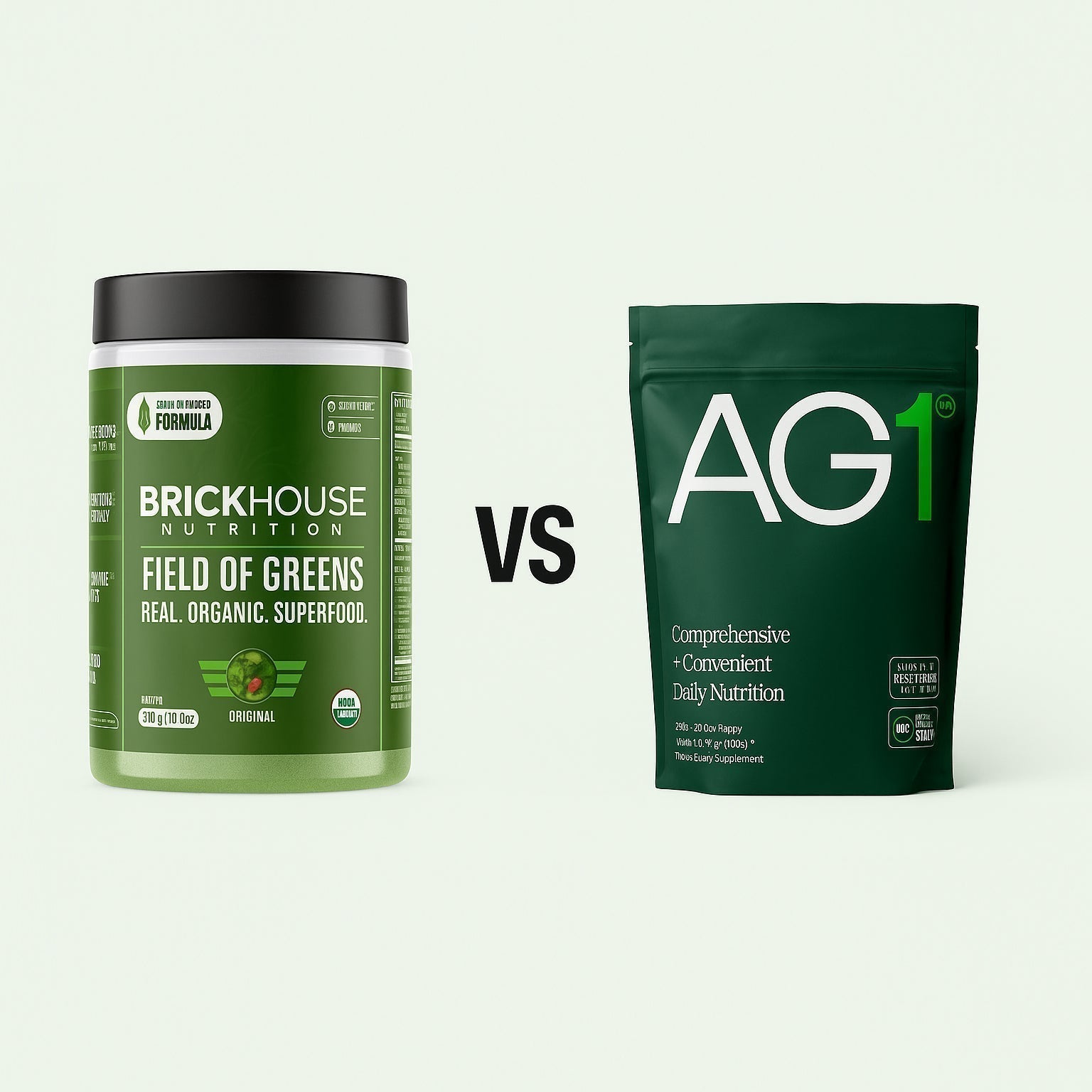
If you're shopping for a greens powder, you've almost certainly heard of Field of Greens and AG1. They're two of the most popular options on the market, so we're putting them head-to-head in an honest breakdown. No fluff. No trash talk. Just the facts that actually matter when you're trying to make one less decision about your health.
Here's the short version: both are solid products, but they're built on very different philosophies. AG1 Next Gen is a big, everything-but-the-kitchen-sink formula with 83 ingredients, while Field of Greens is a focused, whole-food blend of 20-plus USDA Organic fruits and vegetables backed by a peer-reviewed clinical study. If you want real food nutrition you can actually pronounce, Field of Greens is probably your answer. If you want a multivitamin-probiotic-adaptogen-superfood hybrid in one scoop, AG1 Next Gen is built for that.
Now let's get into the details.
Most people pick up a greens powder because they know they're not eating enough fruits and vegetables. The problem however, is that the greens powder industry has turned into a marketing arms race. Brands keep adding ingredients, adaptogens, mushrooms, enzymes, and blends just so they can put bigger numbers on the label. And more ingredients isn't always better.
The two products we're comparing today sit on opposite ends of that spectrum. AG1 is famous for claiming it’s the most comprehensive greens powder on the market. Field of Greens takes the opposite approach. It's built around real, organic fruits and vegetables in a simple, focused formula. Different paths for different goals.
Neither one is “wrong.” But one of them probably fits your life better than the other. Let's figure out which.

AG1 recently rolled out a new version of its formula, called AG1 Next Gen. If you've been watching the brand for a while, this is the biggest update since they renamed Athletic Greens to AG1 back in 2021.
Here's what changed. AG1 Next Gen now comes in three flavors instead of just one. You can pick Original (the classic pineapple and vanilla taste), Citrus (lemon and orange), or Berry (blueberry and strawberry). The serving size is now 13 grams per scoop, and each scoop delivers 40 calories, 6 grams of carbs, 2 grams of fiber, less than 1 gram of naturally occurring sugar, and 2 grams of protein.
The formula itself is still massive. AG1 Next Gen packs 83 ingredients into one scoop. On the actual label, those are organized into a vitamin and mineral panel plus three proprietary blends: an Active Superfood and Prebiotic Complex, a Daily Phytonutrient Complex, and a Dairy-Free Probiotic Complex. Next Gen also brings a B-vitamin complex, added cocoa extract, and boron, while staying iron-free.
AG1 positions this new version as a “Daily Health Drink” designed to replace your multivitamin, your probiotic, and a handful of other supplements all in one scoop. The brand calls this “foundational nutrition.” On the certification side, AG1 keeps its NSF Certified for Sport status, which is a legit third-party certification that confirms the product is free from more than 280 banned substances. That matters if you're a competitive athlete. The Next Gen formula is also non-GMO and contains zero added sugar.
On price, AG1 Next Gen costs $99 (plus $9 shipping) for a one-time 30-serving pouch, or $79 per month on subscription with free shipping. That comes out to roughly $2.63 per scoop on subscription, or about $3.30 per scoop if you buy it one bag at a time.
AG1 Next Gen is a more potent, flavor-flexible version of what AG1 has always been. It's a busy formula that leans hard on the “one scoop for everything” promise. For some people, that's exactly what they want.

Field of Greens, made by BrickHouse Nutrition, takes a completely different approach to AG1.
Instead of cramming 80+ ingredients into one scoop, Field of Greens is built around a simpler idea: if you can't eat enough real fruits and vegetables, drink them. The formula is built on more than 20 USDA Organic-certified fruits, vegetables, and herbs. No extracts pretending to be whole foods. No synthetic add-ins trying to match a multivitamin's label. Just real produce, freeze-dried and powdered.
The formula is organized into a few clean blends. There's an Organic Greens Blend with things like spirulina, wheatgrass, kale, barley grass, broccoli, chlorella, banana, apple, and parsley powder. There's an Organic Antioxidant Powder Blend with beetroot, strawberry, raspberry, blueberry, cranberry, and inulin. And there's an Organic Metabolic Powder Blend with ginger, matcha tea, and turmeric. The label also includes 2 grams of organic prebiotic fiber to feed healthy gut bacteria. That's it. No filler, no fluff.
Because the formula is built on real produce, you also get a real vitamin and mineral profile. Each serving delivers vitamin A, vitamin C, vitamin D, vitamin E, vitamin K, thiamin, riboflavin, niacin, vitamin B6, folate, vitamin B12, biotin, pantothenic acid, iodine, magnesium, selenium, chromium, and molybdenum. That's a broad nutritional footprint from whole foods, not a pile of synthetic isolates thrown together to hit a label claim. It's also worth noting that Field of Greens includes vitamin D in the scoop itself, which AG1's greens powder does not.
A serving is 10.34 grams, roughly one scoop. You get about 25 calories per serving with natural flavors and organic stevia for a mild sweetness. Flavor options are broad: Original, Wildberry, Strawberry Lemonade, Lemon Lime, Cucumber Lime, Chocolate, and the newest Pineapple Mango, plus a Raw version with no added sweetener for people who want to mix it into smoothies or already-flavored drinks. Eight options in total.
On price, Field of Greens is $89.95 for a one-time purchase of 30 servings, which drops to roughly $80.96 per tub on subscription. The subscribe-and-save discount shakes out to $2.70 per serving, which is similar in price to AG1. BrickHouse also offers a 60-day money-back guarantee for some added peace of mind.
Field of Greens isn't trying to be everything. It's trying to be the best at one thing: getting real, organic produce into your body every day. It's built for people who are tired of decoding supplement labels and just want something honest and effective in their morning glass.
Here's where the two products really separate.
AG1 Next Gen is a proprietary blend of more than 80 ingredients. That list includes vitamins and minerals, probiotics, adaptogens like ashwagandha and rhodiola, mushrooms, digestive enzymes, and a long list of plant extracts. Some of these ingredients are whole food powders. Many are extracts, isolates, or synthetic forms of vitamins. AG1 doesn't publish exact amounts for every ingredient because the formula is proprietary. That's normal in the industry, but it does mean you're trusting the brand's math rather than reading the label.
Field of Greens takes the opposite approach. The formula is smaller, but it’s almost entirely made of real freeze-dried, USDA Organic produce, with a clear vitamin and mineral profile built on top of that whole-food foundation. No isolated plant extracts standing in for whole foods. No mushroom blends. No long list of adaptogens. Just fruits, vegetables, and a few organic herbs doing the work. BrickHouse's physicians designed Field of Greens to work the way food works, not the way a laboratory does.
Which approach is better? That depends on what you want from a greens powder.
If you already take a multivitamin and a probiotic, AG1's all-in-one approach may be overkill. Some people like that convenience. Others find it to be too much, especially when you can't always tell how much of each ingredient you're actually getting.
If you’re looking for a reliable way to boost your daily produce intake with real, organic food, Field of Greens is the more honest fit. You're getting roughly two servings of real fruits and vegetables from real kale, real spirulina, real blueberries, and real beets. The way your grandma would have done it, if your grandma had a freeze-dryer and a USDA inspector.
One more ingredient note worth flagging. AG1's larger formula means more chances for potential side effects. Some users report stomach discomfort or bloating when they first start AG1, which is why the brand recommends easing in with smaller doses for the first few days. Field of Greens is generally better tolerated because the ingredient list is shorter and based on whole foods, not concentrated extracts and adaptogens.
Both brands talk a big game about research. Let's actually look at what's there.
AG1 cites several clinical trials on its website. These include a triple-blind placebo-controlled trial with 105 healthy adults over 12 weeks, plus a handful of smaller crossover and bioavailability studies. AG1 reports findings like a 70% increase in red blood cell folate levels, a 73% increase in vitamin C levels, and a 10x increase in certain healthy gut bacteria.
BrickHouse takes testing seriously as well, and Field of Greens is backed by a published, peer-reviewed clinical trial from a major research university.
The study was conducted at Auburn University and published in February 2026 in Frontiers in Nutrition, a peer-reviewed scientific journal. It was a randomized crossover-controlled trial, which is the gold standard for nutrition research. Twenty adults between the ages of 50 and 65 with a BMI over 30 took Field of Greens daily for 30 days while researchers tracked four different epigenetic aging clocks, gut microbiome markers, metabolic biomarkers, body composition, sleep, and dietary intake.
Here's why that matters. Epigenetic aging clocks measure how fast your body is aging at the cellular level. They're some of the most advanced tools scientists have for tracking biological age. The Auburn team used four of them, including two newer-generation clocks called AdaptAge and DamAge. AdaptAge tracks your body's ability to adapt to stress. DamAge tracks accumulated cellular damage linked to inflammation, pollution, and poor lifestyle habits.
The results showed trends toward improvement on both AdaptAge and DamAge during the 30-day Field of Greens supplementation period compared to the control period. BrickHouse reports that over 60% of participants showed a measurable reduction in biological aging markers after just 30 days. The researchers also found meaningful changes in specific gut microbes, including Bilophila and Desulfobacterota, which are associated with inflammation and metabolic health.
The study isn't perfect since it was a small sample size and the intervention was only 30 days, but the results were promising. The researchers were also careful to call their findings exploratory and hypothesis-generating, which is standard scientific language.
But here's what's genuinely important. Field of Greens is the only major greens powder we're aware of that has been studied this way and published in a peer-reviewed nutrition journal. It's a real study, with real people, measured with real tools, published in a real journal. That's a higher bar than most supplement brands will ever clear.
If clinical evidence matters to you, and it should, this is a meaningful difference.
AG1 is NSF Certified for Sport. This is a well-respected third-party certification run by NSF International. It confirms that the product is free from more than 280 banned substances, that the ingredients on the label match what's actually in the container, and that the facility meets strict manufacturing standards. If you're a competitive athlete subject to drug testing, NSF Certified for Sport is a real advantage. It's one of the most trusted certifications in the supplement world.
Field of Greens isn’t NSF Certified for Sport, but it is third-party tested for purity and contaminants, and it carries the full USDA Organic certification, which AG1 does not. USDA Organic is a federally regulated standard that requires ingredients to be grown without synthetic pesticides, synthetic fertilizers, or GMOs. It's audited and verified by third-party certifiers working under USDA oversight.
So the question becomes: what matters more to you? For a competitive athlete, NSF Certified for Sport is probably the bigger deal. For almost everyone else, USDA Organic is arguably more meaningful day to day. Organic certification covers how the food is grown, which affects what ends up in your body over years of consumption. Banned substance testing is important but mostly relevant if your career depends on passing a drug test.
There's also a regulatory difference worth understanding. Dietary supplements, including AG1, aren't reviewed or approved by the FDA before they hit shelves. That's true of every supplement on the market, including the ones that imply otherwise in their marketing. Field of Greens takes a different path. It's classified and regulated as a food, not a dietary supplement, which means it falls under the FDA's food regulations. That's why the package carries a Nutrition Facts panel instead of a Supplement Facts panel. It's a small detail on the label, but it reflects a real regulatory distinction: food ingredients are held to food-safety standards, and BrickHouse stands behind Field of Greens with that in mind.

Taste matters. You're going to drink this stuff every morning, and if you hate it, you'll stop.
AG1's original flavor has been described as a mix of pineapple and vanilla. It's an earthy, mildly sweet taste that some people love and others find a little unusual. With the new AG1 Next Gen, you also get Citrus and Berry options, which were designed to give people more variety. AG1 uses stevia as its sweetener, so it's naturally sweetened with no added sugar. Mixability can be an issue. Some users report sediment at the bottom of the shaker if the drink sits too long.
Field of Greens has a reputation for being easier on the palate. The Original flavor is light, slightly sweet, and naturally fruity thanks to the real apple, berry, and beet in the blend. If the original feels too mild, there's plenty of variety to choose from: Wildberry, Strawberry Lemonade, Lemon Lime, Cucumber Lime, Chocolate, Pineapple Mango, and a Raw version with no added sweetener for smoothie mixing. That's eight total flavor options. Most users say Field of Greens mixes smoothly in water or a shaker bottle without the grit some other greens powders leave behind.

Life doesn't pause for your health routine. If you travel for work, hit the gym before sunrise, or spend big chunks of your week away from your kitchen, dragging around a full tub of greens powder isn't exactly practical. Both brands have a solution: single-serve travel packs.
Field of Greens Travel Packs come in boxes of 15 individual packets, priced at $46.95 per box. Each packet delivers the same clinically studied, USDA Organic blend you'd get from a scoop out of the tub, just sealed up and portable. Toss a few in a suitcase, a gym bag, or a desk drawer, and your routine travels with you.
AG1 Travel Packs are also available for the Next Gen formula. A 30-pack runs $109 as a one-time purchase, or $89 per month on subscription. Same formula, same flavor options, same 13-gram serving size as the pouch, individually sealed for the road.
Travel packs run a slight premium per serving compared to the tub or pouch. That's the trade-off for the convenience. But if the alternative is skipping your greens on travel days, they earn their price tag fast. Consistency is the whole game with a daily greens powder, and travel packs make consistency a lot easier to pull off.
AG1 Next Gen is a good fit if you want a comprehensive, all-in-one supplement and you don't mind paying premium prices for it. It makes the most sense if you're not already taking a multivitamin, a probiotic, or an adaptogen and you want one scoop to cover all of that. The NSF Certified for Sport status is a real advantage if you're a competitive athlete or just want that extra layer of banned-substance testing.
AG1 is also a fair pick if you like the idea of adaptogens and functional mushrooms in your routine. The formula leans hard in that direction with ingredients like ashwagandha, rhodiola, and reishi. Some people feel a real benefit from adaptogens. Others don't notice much. Either way, it's there if you want it.
You might want to skip AG1 if you're sensitive to ingredient-heavy formulas, if you've had stomach issues with greens powders before, if you care deeply about organic certification, or if the price feels steep for your situation.
Field of Greens is designed for real life, for real schedules, and for real health that gets built one day at a time.
Choose Field of Greens if you want real, USDA Organic fruits and vegetables as your foundation. Pick it if you're tired of decoding long supplement labels and you'd rather trust a short list of ingredients you can actually recognize. Pick it if you want the reassurance of a published, peer-reviewed clinical study behind your morning scoop. Pick it if you like the idea of a physician-formulated product without the premium price tag.
Field of Greens is also a good choice for households, because the formula is safe for the whole family. Not every greens powder can say that.
Both of these products have earned a spot in the greens powder conversation. But when you strip out the noise and look at what actually matters for most people, Field of Greens comes out ahead.
You're getting real, USDA Organic fruits and vegetables instead of a proprietary pile of extracts and powders. You're getting a shorter, cleaner formula that your body can actually recognize. You're getting peer-reviewed clinical research, which is something almost no other greens powder in the category can say. You're getting a better price per serving, a sensible 60-day guarantee, and a product that's physician-formulated by a team that's obsessed with your wellness, not with label claims.
Real health isn't hyped. It isn't hacked. It's built brick by brick. One honest scoop at a time. If you're ready to stop second-guessing your greens powder and start building a routine you can actually trust, Field of Greens is the clearer choice for most people.

Try it for 60 days. If it's not right for you, BrickHouse will send your money back. That's a pretty low-risk way to find out if the simpler path is the better one.
Yes. All of the fruits, vegetables, and herbs in Field of Greens are USDA Organic certified. USDA Organic certification is a federally regulated standard that verifies ingredients were grown without synthetic pesticides, synthetic fertilizers, or GMOs.
AG1 lists several clinical trials on its website, including a triple-blind placebo-controlled study with 105 adults over 12 weeks. These studies support AG1's claims about nutrient gaps and gut microbiome changes. Field of Greens differs in that its clinical research has been published in a peer-reviewed scientific journal, Frontiers in Nutrition, as of February 2026. That level of independent peer review is rare in the greens powder category.
The Auburn University study tested Field of Greens in adults aged 50 to 65 with a BMI over 30. Over 30 days, researchers tracked four epigenetic aging clocks, gut microbiome markers, and metabolic health indicators. Results showed trends toward improvement on the AdaptAge and DamAge biological aging clocks, meaningful shifts in specific gut microbiome taxa linked to inflammation, and over 60% of participants showed measurable improvements in biological aging markers. The study was published in Frontiers in Nutrition in February 2026.
Yes. Field of Greens is made from real USDA Organic fruits and vegetables with no synthetic ingredients or fillers, which makes it safe for most age groups. As with any supplement, it's smart to check with your doctor if you're pregnant, nursing, taking prescription medications, or have a specific medical condition. AG1 is not recommended for people under 18 or for pregnant or breastfeeding women.
Yes. BrickHouse Nutrition partners with Truemed to make its products HSA/FSA eligible for qualified customers. At checkout, look for the Truemed option to pay with your HSA or FSA card or submit for reimbursement. A licensed healthcare provider will review a brief health survey to determine your eligibility. It's a nice way to take some of the sting out of the monthly cost using pre-tax dollars you've already set aside for your health.
Field of Greens is available on Amazon and directly from the BrickHouse Nutrition website, where you'll find the full range of flavors (Original, Wildberry, Strawberry Lemonade, Lemon Lime, Cucumber Lime, Chocolate, Pineapple Mango, and Raw) plus subscription options and the 60-day money-back guarantee. Buying direct also keeps you covered by BrickHouse's customer service team and ensures you're getting the authentic, current formula.
These statements have not been evaluated by the Food and Drug Administration. These products are not intended to diagnose, treat, cure, or prevent any disease.
The Different Types of Creatine: Benefits, Usage Tips, and More
In terms of sports performance supplementation, few compounds have accumulated as much attention and scientific research as creatine. Renowned for its potential to enhance athletic performance, imp...
Read more about The Different Types of Creatine: Benefits, Usage Tips, and MoreTypes of Collagen Explained: What’s Inside BrickHouse Nutrition Radiance
When you read the Radiance Supplement Facts label, you’ll notice some Roman numerals you probably haven’t seen since grade school: Type I, Type II, Type III, Type V, and Type X. You’ll also see te...
Read more about Types of Collagen Explained: What’s Inside BrickHouse Nutrition Radiance