Your cart is empty
Free shipping on all US orders

Free shipping on all orders
Your Cart
Your cart is empty
Free shipping on all US orders
Article: BrickHouse Sparkling Greens vs. Huel Daily Greens: Ready-to-Drink Greens Comparison
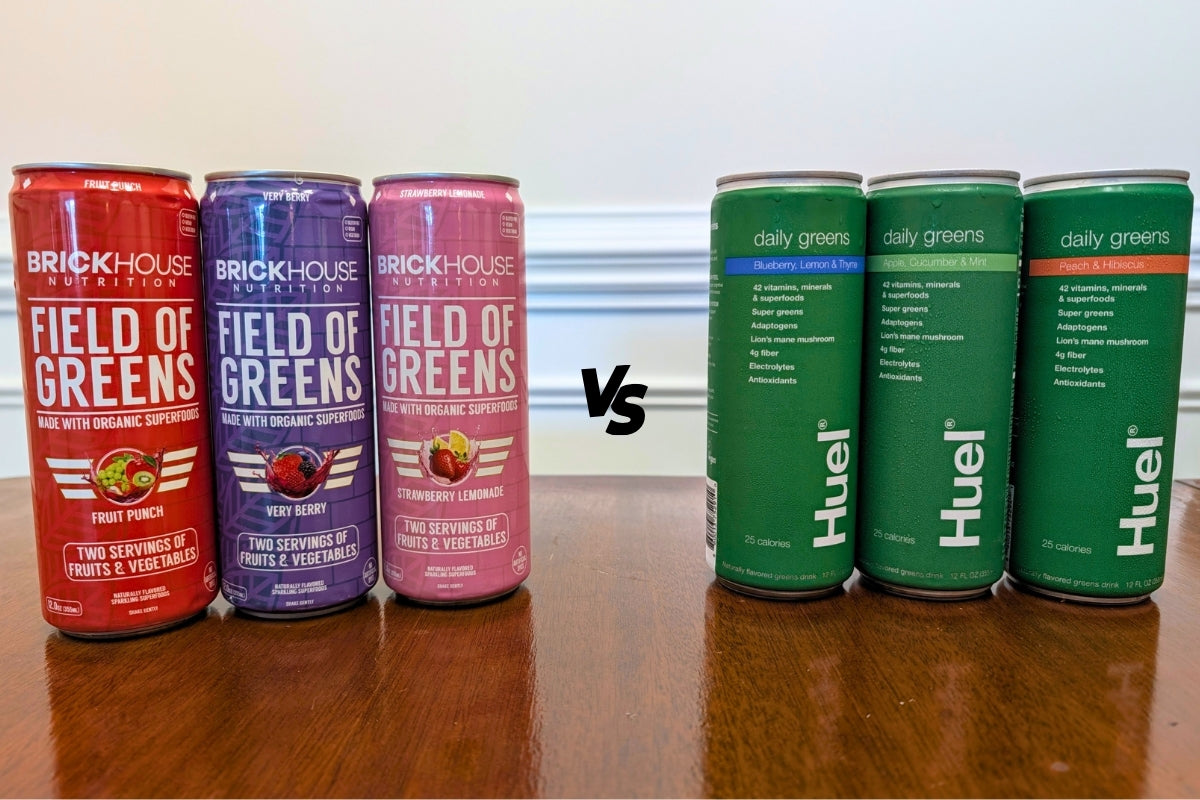
If you've ever looked into adding more fruits and vegetables to your diet, you've probably considered a greens powder supplement. Scoop some powder into a shaker bottle, add water, mix it up, and you've got an easy way to add greens to your daily routine.
As greens supplements became more popular, travel packs hit the market, making it even easier to take your greens with you on-the-go.
Now, there’s a new iteration. Ready-to-drink, carbonated greens in a can.
No powder. No scoop. No shaker bottle required. Just grab a cold can, crack it open, and take a sip.
BrickHouse Nutrition Sparkling Greens and Huel Daily Greens RTD are among the few ready-to-drink greens products currently available. So we decided to put them to the test, comparing the two side by side on ingredients, nutrition facts, price, flavors, taste, and more.
| BrickHouse Sparkling Greens | Huel Daily Greens RTD | |
|---|---|---|
| Price | $3.99/can (4-pack) → $3.25/can (24-pack) subscription | $3.55/can → $2.67/can subscription |
| Calories | 30 | 25 |
| Total sugars | 0g (0g added sugar) | 1g (0g added sugar) |
| Dietary fiber | 2g (7% DV) | 4g (14% DV) |
| Organic ingredients | 21 Organic ingredients across the Greens, Antioxidant & Metabolic blends | 1 ingredient labeled Organic: KSM-66 Ashwagandha |
| First ingredients | Carbonated water, then Organic Greens Blend with spirulina, wheatgrass, kale, barley grass, broccoli, and chlorella | Water, soluble chicory root fiber, citric acid, natural strawberry flavor, then juice concentrates |
| Sweetener | Stevia leaf extract | Stevia leaf extract (Reb MD) |
| Other key ingredients | Organic fruits, vegetables, berries, inulin, ginger, matcha, turmeric, vitamins, minerals | Juice concentrates, greens, chicory root fiber, vitamins, minerals, adaptogens |
The front of a greens can is designed to grab your attention, but the ingredient list tells you what’s actually inside.
BrickHouse Sparkling Greens starts with carbonated water, followed by an Organic Greens Blend containing spirulina, wheatgrass, kale, barley grass, broccoli, chlorella, banana, apple, and parsley.
Then comes an Organic Antioxidant Blend with blueberry, cranberry, raspberry, strawberry, beet root, and inulin, followed by an Organic Metabolic Blend with ginger, matcha, and turmeric.
That's a formula built around fruits, vegetables, and natural plant ingredients.
Huel's Daily Greens RTD ingredient list starts with water and soluble chicory root fiber, followed by citric acid and natural flavors. The formula then includes vegetable and fruit juice concentrates, adaptogens including ashwagandha and lion’s mane, and a long list of added vitamins and minerals.
There's nothing inherently wrong with that approach. Huel provides meaningful amounts of most vitamins and minerals, along with four grams of fiber, fruit and vegetable ingredients, and adaptogens.
But there's a clear difference in how the formulas are built.
BrickHouse puts whole-food plant ingredients at the center, while Huel focuses on fiber, added vitamins and minerals, and functional ingredients.
If you're looking for a greens drink because you want to add more fruits and vegetables to your diet, that's a difference worth paying attention to.
The biggest difference between these two products comes down to what each drink delivers beyond the basic calorie and macronutrient profiles.

(Nutrition Facts panel courtesy of Huel)
Huel has the advantage when it comes to the vitamin and mineral concentration. Many of its micronutrients provide close to 100% of the recommended Daily Value per can.

On the other hand, BrickHouse Sparkling Greens has most vitamins and minerals sitting closer to 20% of the recommended Daily Value.
That's because BrickHouse Sparkling Greens is designed to supplement your diet with whole-food plant ingredients, not provide your entire daily dose of vitamins and minerals in a single can.
For BrickHouse, the focus is on where those nutrients come from. Its formula uses organic whole-food plant ingredients, including real fruits, vegetables, and herbs, rather than relying primarily on juice concentrates.
There are also a few minor nutritional differences worth mentioning. Huel provides 4 grams of fiber per 12-ounce can compared with 2 grams in BrickHouse, giving Huel the edge for fiber. Huel also contains 1 gram of naturally occurring sugar from its fruit and juice ingredients, with 0 grams of added sugar. BrickHouse contains 0 grams of sugar.
Calories are also nearly identical at 30 calories for BrickHouse and 25 calories for Huel. That difference is pretty negligible for most people.
Ultimately, this comparison comes down to what you're looking for from a greens drink.
Huel is a solid option if your priority is getting a larger percentage of your daily vitamins and minerals in a can. BrickHouse wins if you want an organic greens drink built around whole-food plant ingredients.

BrickHouse Sparkling Greens is currently available in:
Huel provides a few more flavor choices, with:
The taste test comparison was pretty close, with both brands doing a good job of making a greens drink taste more like a refreshing sparkling beverage.

BrickHouse Sparkling Greens Strawberry Lemonade had a refreshing flavor, with both the strawberry and lemon coming through nicely. It didn't taste artificial or grassy, and I liked that it wasn't overly sweet. That made it feel more like a drink you could actually enjoy every day instead of something you're forcing down just for the nutrition. The texture was a little more noticeable than Huel's, with more body and a consistency similar to a traditional greens powder mixed with water. It was still easy to drink, and the formula is free from artificial sweeteners, colors, and flavors.

Huel's Peach Hibiscus had a solid peach-forward flavor, with a slightly sweeter taste than BrickHouse. It was noticeably lighter in color and tasted more like a flavored sparkling soda than a traditional greens drink. The formula is free from artificial ingredients, and it had a smooth, easy-to-drink consistency.
Price point is another area where Huel has a slight advantage.
BrickHouse currently lists its 4-pack at $3.99 per can, with the per-can price dropping to $3.59 (4-pack) or $3.25 (24-pack) with a subscription
Huel starts at $3.55 per can and drops to $2.67 per can with its subscription discount.
You're paying a little more for BrickHouse, but you're also getting an organic formula built around whole-food plant ingredients. Huel offers a lower price point, more vitamins and minerals, and 2 grams of additional fiber.

Let’s start with the biggest advantage of both of these products: convenience. You can grab a cold, tasty, ready-to-drink greens beverage straight from the fridge without measuring powder, mixing it with water, or cleaning a shaker bottle afterward.
Huel provides 4 grams of fiber per can, a broad range of vitamins and minerals, and a lower price, especially with a subscription. It also comes in five flavors, giving you a few more options if variety is important to you.
BrickHouse takes a different approach, focusing on whole-food plant ingredients. Each can provides two servings of your daily fruits and vegetables, and the formula uses organic ingredients.
The right choice really comes down to what you're looking for in a greens drink. If you want more fiber, a significant source of vitamins and minerals, and a slightly lower price, Huel has a lot going for it. If you'd rather have an organic formula built around whole-food sources of fruits, vegetables, greens, and berries, BrickHouse Sparkling Greens may be a better fit.
Both are convenient, both are easy to drink, and neither requires you to mix a powder yourself. If BrickHouse sounds like a better fit for your routine, give Sparkling Greens a try. You can choose from 4-, 12-, or 24-packs, and based on my taste test, I'd highly recommend the Strawberry Lemonade flavor.
Greens Powders vs. Multivitamins: Which Supplement Is Right for You?
Two of the most popular options for filling nutritional gaps are greens powders and multivitamins. At first glance, they seem like they serve the same purpose. Both are designed to supplement your ...
Read more about Greens Powders vs. Multivitamins: Which Supplement Is Right for You?
Available for iOS and Android
Sign up to get the latest updates and product releases

© 2026 BrickHouse Nutrition, llc. All rights reserved.